

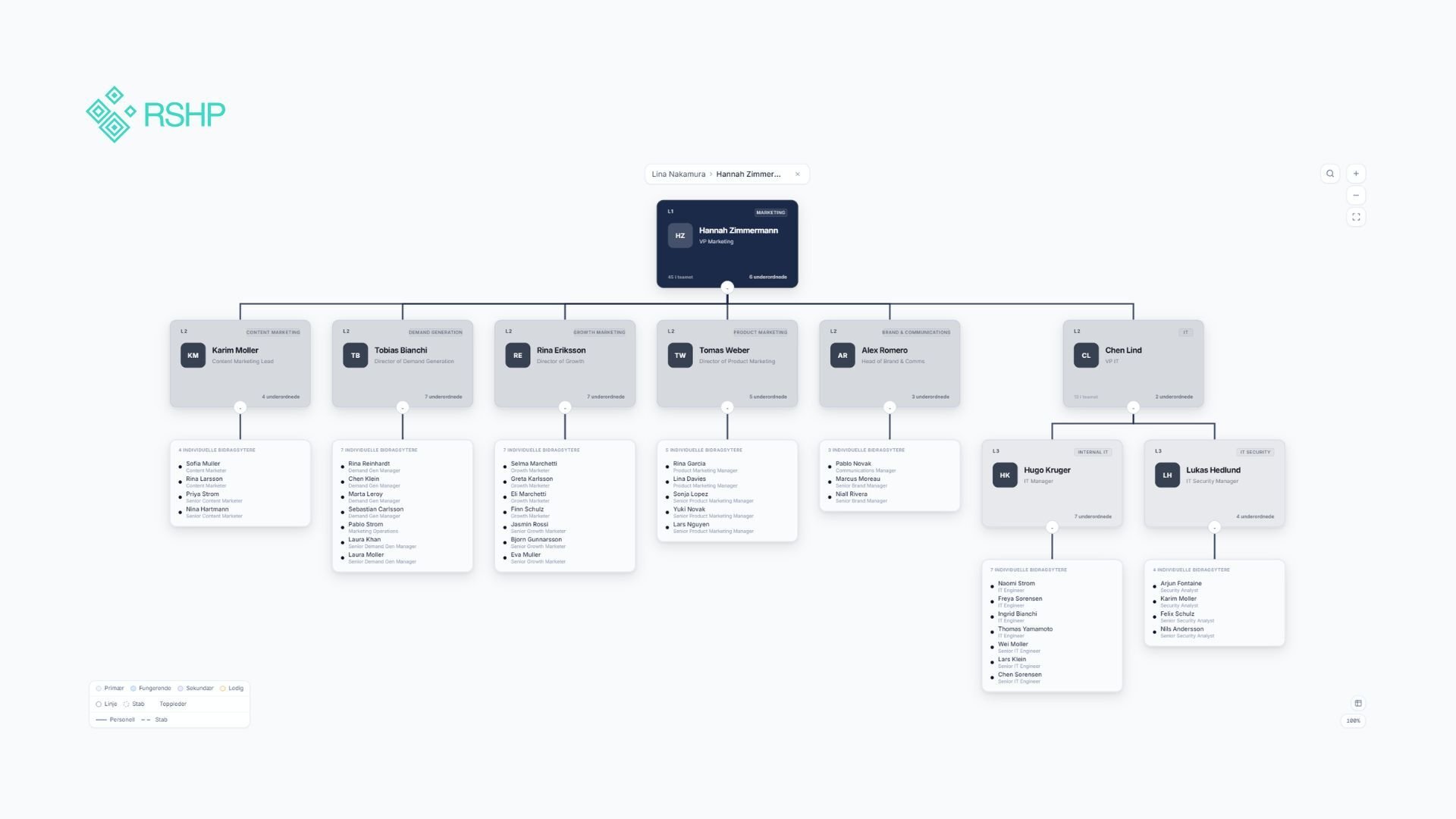

Consider a company seven years old, grown from a founding team of fifteen to something approaching 400 people. The org chart exists; it lives in Lucidchart or a Powerpoint presentation somewhere, maintained diligently by whoever is in the People function, updated whenever someone joins or leaves or changes managers. On any given morning, the CEO or some other manager can pull it up and see, at a glance, who reports to whom across every function and team. In this sense, the organisation is fully documented.
But something interesting happens when the leadership team begins putting together a board deck on the plan to grow from 400 to 700 people over the next eighteen months. Nobody can cleanly describe what the organisation should look like at the other end of that journey because the current structure has only ever been described in relational terms, as a set of reporting lines, and never in structural ones, as a set of deliberate choices about how work should be divided and valued. The same gap appears when a senior candidate, late in the interview process, asks what the actual difference is between a "Senior" and a "Principal" in this company; what work each level does, what authority each carries, what the progression actually requires. The hiring manager improvises a thoughtful-sounding answer that may or may not match what a different hiring manager said to a different candidate last month. And it surfaces most sharply when, for the first time, a regulator asks the company to explain the criteria by which it set the pay ranges listed in its job postings. The People team discovers that the honest answer is: market surveys, hiring negotiation history, and whatever felt right at the time
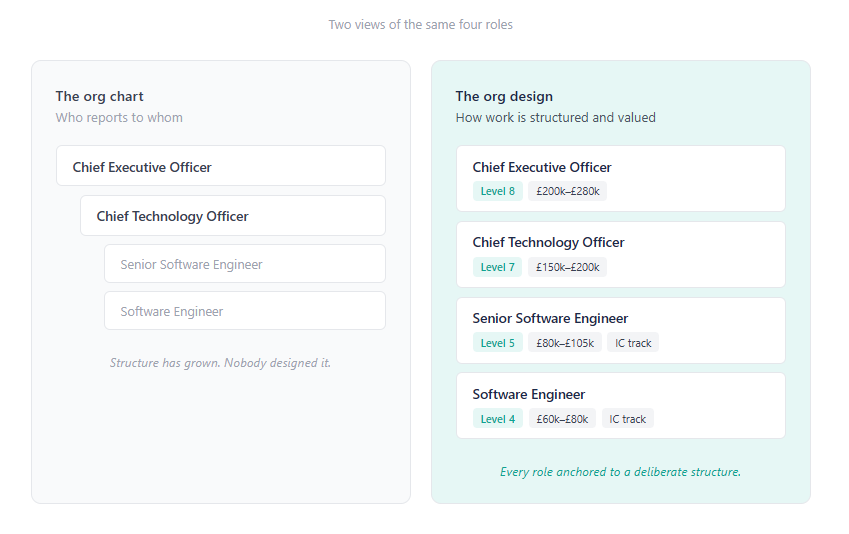
At that point, the org chart is no help at all. It shows reporting relationships. It shows nothing about how work is structured, how different roles are valued relative to one another, whether people doing comparable work are being paid consistently, or whether the shape of the organisation makes sense for the strategy it is supposed to support. It is a record of who works for whom. It is not a design.
The org chart as a concept is roughly 170 years old. Daniel McCallum, superintendent of the New York and Erie Railroad in the 1850s, needed a way to manage thousands of workers spread across hundreds of miles of track, and produced what is widely recognised as the first modern organisational chart: a schematic of reporting relationships designed to show where authority sat and how information should flow up and down the hierarchy.[^1] The chart solved a real coordination problem, and the basic form has remained largely unchanged ever since.
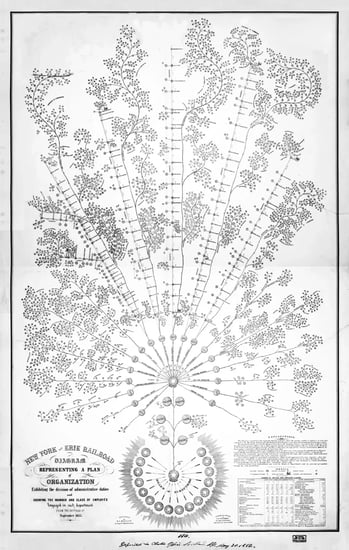 What McCallum's chart could not show (and what almost no org chart has captured in the century and a half since) is anything about the nature of the work itself. It shows hierarchy; it does not show how the organisation has chosen to divide work into roles, how those roles are valued relative to one another, what distinguishes one level of contribution from the next, or how compensation should follow from any of this. These questions require a fundamentally different kind of thinking.
This is the distinction between organisational *structure* and organisational *design*. Structure is what you have: the arrangement of reporting relationships, the grouping of functions, the layers of management that have accumulated as the company grew. Design is the discipline of making deliberate choices about that structure, grounded in a coherent understanding of what kinds of work the organisation does and how those different kinds of work relate to one another in terms of complexity, responsibility, and value. Every organisation has structure. Far fewer have been designed.
A discipline that enterprises kept to themselves
Organisational design has been a serious intellectual tradition for well over a century, even if that tradition has rarely been visible to anyone outside large enterprises and their consulting partners.
Frederick Winslow Taylor's work on scientific management in the 1880s and 1890s was, at its core, an attempt to bring systematic analysis to how labour should be divided and directed — to replace custom and habit with observation and method.[^2] Henri Fayol articulated principles of organisation in 1916 that still run through management thinking today.[^3] By the 1970s, Jay Galbraith had developed his Star Model, which showed how strategy, structure, processes, rewards, and people need to function as an integrated system rather than as independent decisions; you cannot reorganise the structure without considering the implications for how work flows, how people are rewarded, and whether the right capabilities exist to operate in the new configuration.[^4] Lawrence and Lorsch's work on differentiation and integration gave managers a framework for thinking about where to centralise and where to allow autonomy, and why that balance depends on the environment the organisation is operating in.[^5]
What these frameworks share is a fundamental insistence: organisational structure is not a natural phenomenon that emerges inevitably from the work to be done. It is a set of choices, and those choices have consequences for how efficiently an organisation operates, how fairly it treats its people, and how well it can adapt when conditions change.
For most of the past century, access to this thinking was effectively confined to large enterprises. The organisations that could engage McKinsey, Deloitte, or the Hay Group received structured job evaluation methodologies, compensation frameworks grounded in systematic analysis of what different kinds of work actually require, and recommendations for how to organise work relative to strategic intent. The cost of accessing this methodology was substantial, both in fees and in the expectation that the client had a dedicated HR infrastructure capable of maintaining what the consultant built.
Mid-market companies, those with 200 or 500 or 1,500 employees, were largely left to improvise. They had org charts. Many developed career ladders, usually prompted by a retention problem or a particularly difficult negotiation. They set compensation through market surveys, hiring history, and the intuition of whoever was making the offer. Job titles proliferated without systematic logic. The implicit message from the market was that organisational design was an enterprise discipline, reserved for organisations large enough to justify the investment, and that smaller companies would figure it out as they grew.
What organisational design actually consists of
When practitioners talk about organisational design, they are not referring only to the act of redrawing a reporting structure. They mean the systematic work of defining how work is categorised, valued, and organised, and building the ongoing capability to maintain that thinking as the organisation changes.
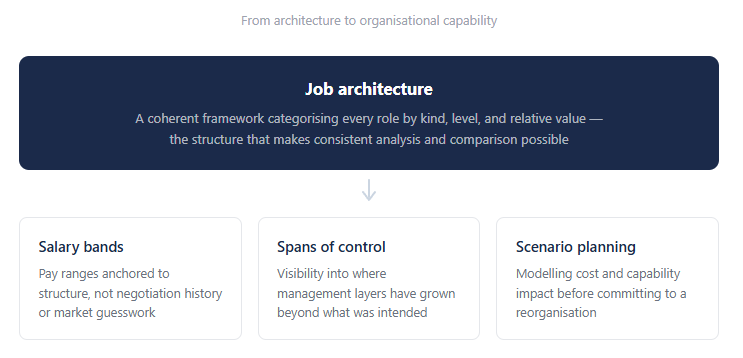 The foundation of this work is job architecture: a coherent framework for categorising every role in the organisation according to what kind of work it represents, what level of contribution and responsibility it involves, and what criteria distinguish one level from the next. Job architecture is to an organisation what a chart of accounts is to a finance function — the underlying structure that makes consistent analysis and comparison possible. Without it, everything else becomes improvisation.
From job architecture, other capabilities follow. Salary bands that are anchored to the architecture, rather than negotiated independently for each hire, become defensible and consistent across the organisation. Analysis of spans of control (how many direct reports each manager carries, and whether that distribution is intentional) becomes possible when you have a systematic view of where management roles sit. Scenario planning, the ability to model what happens to cost and capability when you consider a reorganisation, becomes meaningful when the data it draws on has been structured rather than accumulated ad hoc.
Perhaps most importantly, organisational design makes visible what is otherwise invisible: where work is concentrated in ways that create fragility, where layers of management have grown in ways that slow decisions, where pay has drifted inconsistently away from the architecture that was supposed to hold it in place. The company that cannot describe what its organisation should look like at twice the current size is not suffering from a planning problem. It is suffering from a design problem: the organisation was never given the structure that would make that question answerable.
Why this matters now
For a long time, the invisibility of these things had limited consequences. Compensation inconsistencies were internal and private. Structural inefficiencies were absorbed into operational costs. Regulators, employees, and candidates had limited means and, in most markets, limited legal standing to demand a more structured account of how work was valued.
That has changed significantly. Pay transparency legislation now covers more than 60 million American workers across 16 states and Washington D.C., and the EU Pay Transparency Directive, which must be transposed into national law by June 2026, requires every employer to demonstrate a structured, defensible basis for how it defines and values work.[^6] The concept of "work of equal value" introduced by the Directive (the requirement to compare roles across functions on objective criteria) cannot be addressed without a genuine job architecture; market rates and departmental custom, the two methods most commonly used to set pay, are explicitly excluded as valid bases of comparison under the Directive because both can reflect historical patterns of segregation rather than genuine differences in the value of work.[^7]
These regulations do not create the need for organisational design. They expose how many organisations never did it.
Who designed your organisation?
The philosopher Herbert Simon argued, in *The Sciences of the Artificial*, that every human-made artefact embodies the intentions of its designers — that the form of any made thing reflects choices, even when those choices were never made consciously or deliberately.[^8] The same is true of organisations. The org chart that exists because someone once drew a structure for 40 people, and which has been updated reactively ever since as the company grew, is not a neutral record. It is the accumulated residue of hundreds of implicit decisions about how work should be divided, who should have authority, and how much different roles are worth.
The question is not whether your organisation has been designed. Every organisation has been, in the sense that every structure reflects choices — including choices made by default, by omission, or by the simple accumulation of individual decisions that nobody was tracking as a whole. The question is whether those choices were made deliberately, by someone who understood what they were doing, and whether the result still makes sense for the organisation that exists today.
Most companies, if they look closely enough, will find that the honest answer is: not entirely. The structure grew; it was not designed. And the gap between those two things is where most of the real problems actually live, either in compensation fairness, in structural efficiency, in the ability to give a candidate or a regulator or a board a coherent account of how work is organised and valued.
References
1 Daniel McCallum (1815–1878) was General Superintendent of the New York and Erie Railroad from 1854 to 1857. The organisational chart he commissioned, drawn by civil engineer George Holt Henshaw and published in 1855, depicted the railroad's management structure as a tree diagram and is widely cited as the first modern organisational chart. See Alfred D. Chandler Jr., *The Visible Hand: The Managerial Revolution in American Business* (Harvard University Press, 1977), pp. 95–109, for a detailed treatment of McCallum's management innovations and their significance in the development of modern organisational structures.
2 Frederick Winslow Taylor, *The Principles of Scientific Management* (Harper & Brothers, 1911). Taylor's earlier *Shop Management* (1903) had introduced many of the same ideas at a more operational level. His work was foundational in establishing that the division and direction of labour could be subjected to systematic analysis rather than left to craft tradition and individual discretion.
3 Henri Fayol, *Administration Industrielle et Générale* (1916), translated into English as *General and Industrial Management* (Pitman, 1949). Fayol articulated fourteen principles of management — including unity of command, scalar chain, and division of work — that remain influential in organisational thinking.
4 Jay R. Galbraith, *Designing Complex Organizations* (Addison-Wesley, 1973); and *Designing Organizations: An Executive Guide to Strategy, Structure, and Process* (Jossey-Bass, 2002). The Star Model places strategy at the centre and identifies five design policy categories — strategy, structure, processes, reward systems, and people practices — that must be aligned for an organisation to function coherently. Galbraith argues that structure is not independently optimisable: changes to one element of the star necessarily affect the others.
5 Paul R. Lawrence and Jay W. Lorsch, *Organization and Environment: Managing Differentiation and Integration* (Harvard Business School Press, 1967). Lawrence and Lorsch studied organisations in three industries with different environmental uncertainty levels and found that effective organisations achieved both differentiation (specialisation of functions) and integration (coordination across those functions) in ways appropriate to their specific environment — establishing that there is no universally optimal organisational structure, only structures that are more or less fitted to their context.
6 The figure of 60 million workers and 16 states reflects the state of US pay transparency legislation as of 2024. Comprehensive salary range disclosure laws requiring employers to include pay ranges in job postings have been enacted in (among others) California, Colorado, New York, Washington, Illinois, Massachusetts, and New Jersey, with additional states having narrower disclosure requirements. For a regularly updated tracker of state-level pay transparency requirements, see Mercer, *US Pay Transparency Legislative Tracker* (available at mercer.com), or the equivalent tracker maintained by Littler Mendelson.
7 Directive (EU) 2023/970 of the European Parliament and of the Council of 10 May 2023 to strengthen the application of the principle of equal pay for equal work or work of equal value between men and women through pay transparency and enforcement mechanisms. OJ L 132, 17.5.2023, pp. 21–44. Member States are required to transpose the Directive by 7 June 2026.
8 Herbert A. Simon, *The Sciences of the Artificial* (MIT Press, 1969; third edition 1996). Simon's central argument is that artefacts — things made by humans to serve human purposes — are best understood not by their intrinsic properties alone but by the relationship between those properties and the environment in which the artefact is meant to function; design is the activity of devising courses of action aimed at changing existing situations into preferred ones. The observation that designed things embody the intentions and constraints of their designers, even when those intentions were never made fully explicit, runs throughout the book and is most directly stated in Chapter 1.