


Something keeps happening in org design work. You arrive at the question of job architecture - not because it was the stated agenda, not because someone commissioned a job architecture project, but because the work leads there. An organisation is struggling to scale; the people are capable, the culture is strong, and yet something keeps breaking down in how work gets coordinated, how decisions get made, how people understand their own place in the whole. You start pulling the thread, and eventually you find yourself looking at the underlying structure: the jobs, the roles, the levels, the functions, and the logic, or absence of logic, that holds them together.
This happened enough times, across enough different organisations and engagements, that it stopped feeling like coincidence. Job architecture is not a niche concern for compensation specialists or HR operations teams; it is, we have come to believe, one of the foundational conditions of organisational health. And yet, for something so foundational, the tools available to do this work seriously are remarkably limited.
The problem is not understanding
The people we work alongside, leaders, HR directors, management consultants, organisational designers, generally understand that job architecture matters. They have read the literature, or lived through the consequences of its absence: the grade inflation that quietly erodes pay equity, the role proliferation that makes succession planning nearly impossible, the structural ambiguity that leaves employees uncertain who they report to in any meaningful sense. The problem is not a deficit of understanding. It is a deficit of systems built to support the actual work.
What exists today falls into two broad categories. On one side, there are large enterprise platforms, the HR information systems and workforce management suites, that include job architecture as one module among many, subordinate in design philosophy to the broader demands of payroll, compliance, and workforce administration. On the other side, there are spreadsheets. In practice, a great deal of serious org design work happens in Excel, which is a testament to the flexibility of that tool and a damning indictment of what the market has produced. Spreadsheets can carry information, but they cannot carry insight; they do not hold relationships, enforce logic, or make the structure of an organisation visible as a coherent whole.
 Consider what happens when an organisation of several hundred people attempts a job architecture project using the tools typically available to them. The work usually begins with data collection across functions, producing a sprawling matrix of titles, levels, and competencies that quickly exceeds what any single document can meaningfully represent. The consultants or HR team involved will work hard, and they will produce something of value, but much of the intelligence built up through that process, the decisions made, the comparisons drawn, the logic behind the leveling framework, will not survive the project's end. It lives in presentations and workshops, not in a system that the organisation can continue to work with and build on.
This is the gap Reshape is designed to close.
Structure as grammar, not cage
There is a deeper question beneath the practical one, and it is worth being honest about where we stand on it, because it shapes everything about what we are building.
The word "structure," in organisational contexts, tends to carry a particular weight. It suggests hierarchy, constraint, the imposition of order on people who might otherwise flourish in its absence. There is a strain of thinking in contemporary management culture that is suspicious of structure: that values agility and self-organisation, that sees formal role definition as a relic of industrial management, that fears the org chart as a source of rigidity. We understand where this suspicion comes from, and we do not think it is simply wrong. Badly designed structure is genuinely harmful. Structure imposed without care or understanding does constrain, does stifle, does fail people.
But the answer to bad structure is not no structure. It is better structure, and a clearer understanding of what structure is actually for. Our background spans anthropology and management consulting, small specialist firms and the largest advisory practices in the world, and across all of it the same pattern holds: the organisations that perform most consistently, that grow without losing coherence, that manage to keep people genuinely engaged at scale, are not the ones that have eliminated structure. They are the ones whose structure is clear enough, and well-designed enough, to function as a shared grammar rather than a set of rules. When people understand the logic of the organisation they work in — when they can see how their role relates to others, how decisions are supposed to flow, what the levels of the hierarchy are actually meant to represent — they are freer, not less free. They can make better decisions, collaborate more effectively, and grow in directions that make sense both for them and for the organisation around them.
Culture and creativity do not suffer under structure; they suffer under ambiguity. An organisation in which nobody is quite sure what the job levels mean, in which title inflation has decoupled seniority from responsibility, in which functions have proliferated without anyone mapping how they relate to each other, is not a liberated place. It is a confusing one, and that confusion is felt most acutely by the people least able to navigate it through informal networks and accumulated goodwill. Structure done well is not what is imposed on people; it is what allows people to orient themselves, to understand the whole they are part of, and to contribute to it with intention.
This is what we mean when we say that structure enables. Not that it determines outcomes, but that it creates the conditions under which people, teams, and organisations can realise what they are capable of. People and culture are the driving force behind organisational performance; we believe this completely. But that driving force needs a road to run on, and job architecture, done well, is part of how that road gets built.

What we are building
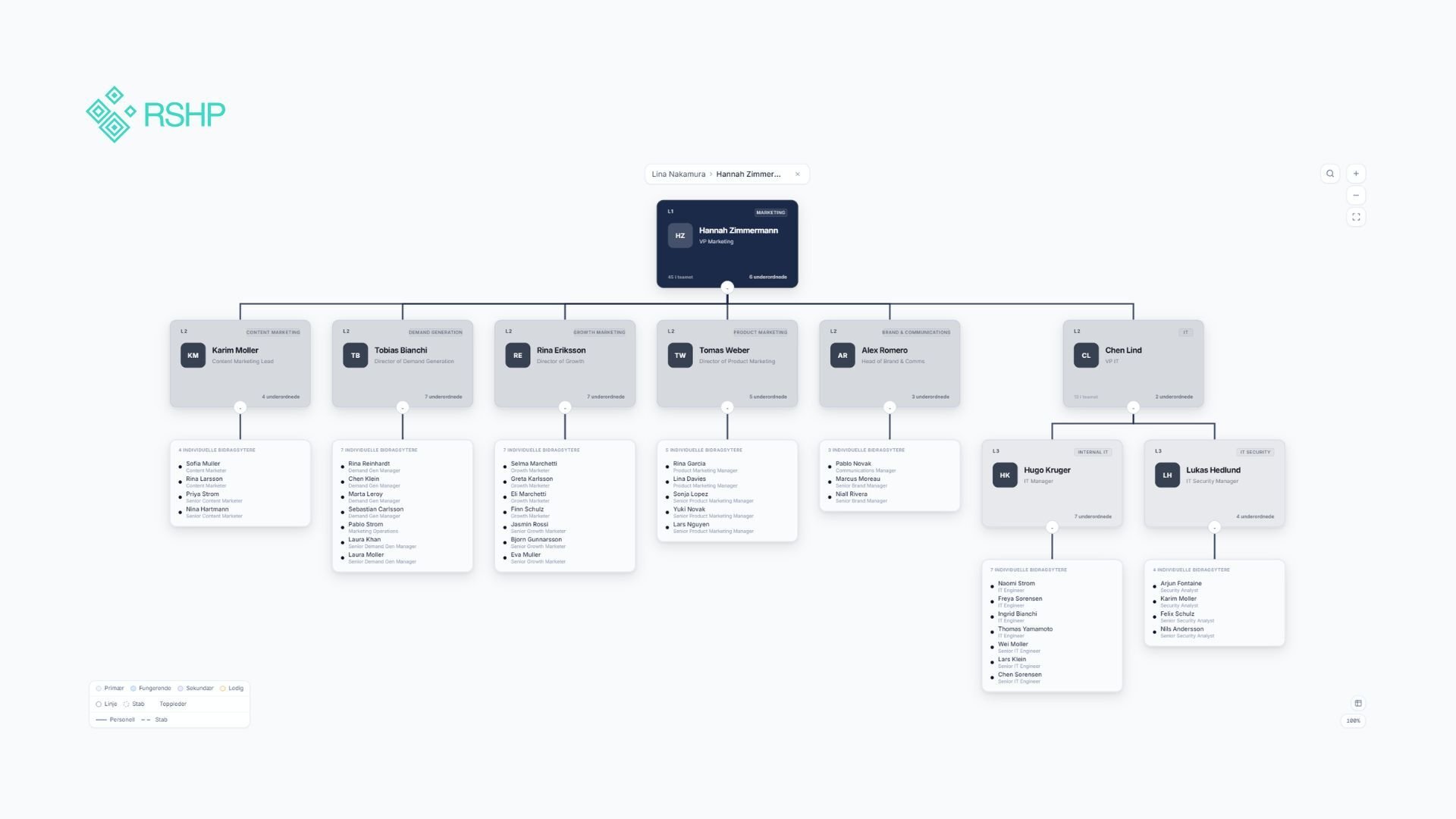
Reshape is a tool built specifically for org design and job architecture work, by people who have done that work and found the available tools wanting. It is not an enterprise platform with a job architecture module. It is not a spreadsheet. It is a system designed from first principles around the actual needs of the work: the need to see an organisation as a coherent whole, to model jobs and roles and levels with proper internal logic, to hold the relationships between functions and families and grades in a way that makes the structure navigable and the decisions made within it traceable over time.
We are building for the consultant running a job architecture project who needs a system that will survive the engagement, for the HR director who wants to own their organisation's structure rather than have it managed by a vendor's data model, and for the leadership team that wants to make structural decisions with a clear view of what they are actually changing. The tool will be opinionated where opinion is warranted, about what good job architecture looks like, about how leveling frameworks should be constructed, about the relationships that matter, and flexible where flexibility is genuinely needed.
We are early. Reshape is in development, and we are building it carefully, in close conversation with practitioners who are willing to think through hard problems with us. If you have arrived here from the waitlist, that is exactly the kind of conversation we want to be having.
An invitation
If the problem we have described is one you recognise, we would like to hear from you. Not as a sales conversation, but because the people who have felt this gap most acutely tend to have the clearest sense of what would actually help, and that is the most useful input we can get at this stage. Reply to this post, reach out directly, or simply watch what we build. We will write when there is something worth saying.